Sherman County Dog Registration Information
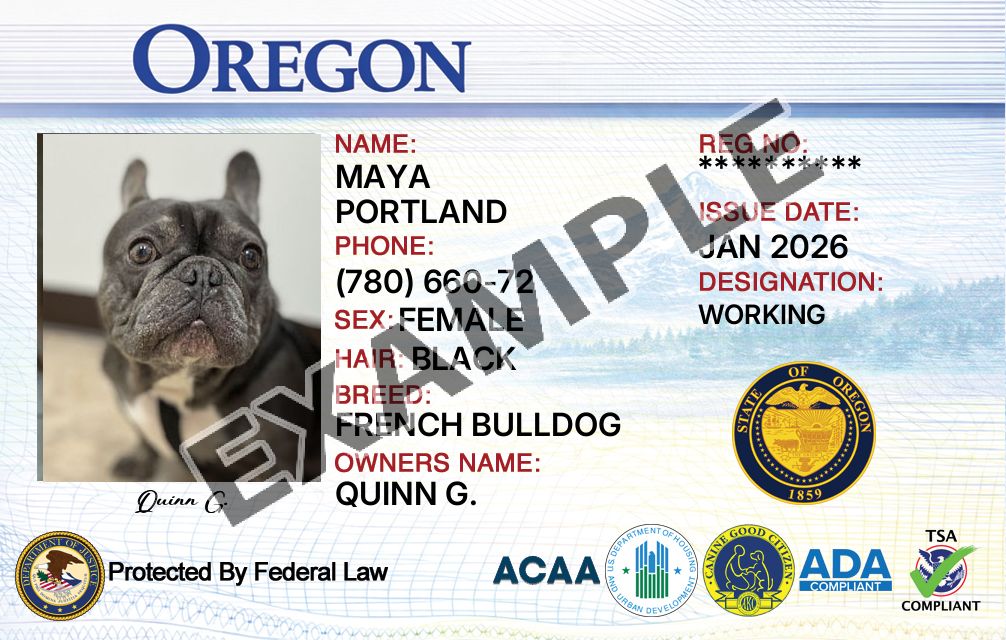
Service Dogs and Emotional Support Animals in Sherman, Oregon
If you’re asking, “where do I register my dog in Sherman County, Oregon for my service dog or emotional support dog,” the answer usually involves two separate topics: (1) local dog license in Sherman County, Oregon (a county or city process often tied to rabies vaccination), and (2) your dog’s status as a service dog or emotional support animal (ESA) (a legal classification that is not issued by a single universal federal registry).
- Dog licensing and “registration” are local: in Oregon, licensing is typically handled by a county office, sheriff/animal control, or a city office if the city has its own program.
- Service dogs and ESAs are not registered through one universal federal government registry: your dog’s legal status generally comes from how the dog is trained/used (service dog) or from clinical documentation (ESA), not from a single nationwide registration database.
- Rabies vaccination proof is commonly required to obtain a license tag, and local rules can vary within the county.
Where to Register or License Your Dog in Sherman County, Oregon
The offices below are verified local government contacts in Sherman County, Oregon that residents commonly use to start with questions about licensing, animal control, and county-administered requirements. If you live inside a city limit (for example, Moro), ask whether the city handles any licensing steps directly or whether the county program applies.
Sherman County Court (Sherman County Courthouse)
Use this office as a starting point if you need confirmation of where to register a dog in Sherman County, Oregon, whether licensing is handled by the county, and which form/payment method is accepted locally.
Sherman County Sheriff’s Office
This is an appropriate contact for animal control dog license Sherman County, Oregon questions, including what to do if you found a dog, dealing with dogs at large, or determining the correct process when you live outside city limits.
City of Moro (Moro City Hall)
If you live inside Moro city limits, contact City Hall to confirm whether any city-specific rules apply and whether the city administers any portion of dog licensing or directs residents to the county process.
Overview of Dog Licensing in Sherman County, Oregon
What “dog registration” typically means locally
In everyday language, “registering” a dog usually means obtaining a license and a tag number recorded by the responsible local agency. A local dog license helps:
- show that the dog has a current rabies vaccination (where required for licensing)
- create a local record that can help reunite you with your dog if they are found
- support local animal services functions (where applicable)
County rules vs. city rules inside Sherman County
Local licensing can differ depending on whether you live:
- Inside a city (for example, within Moro city limits), where the city may have its own dog licensing and control program, or may direct residents to the county program.
- Outside city limits (unincorporated Sherman County), where a county office or a county-designated agency may handle licensing and enforcement questions.
Because the details can depend on your physical address, the most reliable approach is to confirm your correct licensing office using the “Where to Register or License Your Dog in Sherman County, Oregon” contacts listed above.
What You Need Before Registering a Dog
Common documentation and details requested
While specific dog licensing requirements Sherman County, Oregon may vary by jurisdiction and can change over time, most licensing offices commonly ask for:
- Rabies vaccination certificate (often required before a license is issued)
- Owner contact information (name, address, phone)
- Dog details (name, breed/mix, color/markings, sex, approximate age)
- Spay/neuter status (if fee schedules differ)
- Payment (fee amount depends on local rules and dog status)
Rabies vaccination: why it matters for licensing
Many Oregon licensing programs are tied to rabies compliance. Even when a dog is a service dog or an emotional support animal, rabies vaccination requirements (and licensing rules) can still apply. The licensing office can tell you what proof is accepted and whether renewals are annual or multi-year.
Steps to Register or License a Dog in Sherman County, Oregon
Step 1: Confirm the correct licensing authority for your address
Start by determining whether your dog license is issued through the county or your city. Use the office list above and ask:
- “Do you handle dog licensing for my address, or is it handled by another office?”
- “What documentation do you require (rabies certificate, proof of spay/neuter, etc.)?”
- “What are your current fees and renewal intervals?”
Step 2: Gather vaccination proof and supporting documents
Have your rabies certificate ready, plus any spay/neuter documentation if it affects fees. If you recently moved to Sherman County, keep proof of residency available in case the office requests it.
Step 3: Submit your application and pay the required fee (if any)
Licensing may involve an application form plus payment. Some jurisdictions issue a tag that should be attached to the dog’s collar. If the dog is an assistance animal, ask whether the licensing fee is waived or reduced under applicable rules.
Step 4: Keep a copy of your records and renewal date
Keep copies of the license record and rabies certificate, and track renewal deadlines. If your contact information changes, update it with the office that issued the license to help ensure you can be reached if your dog is found.
Service Dog Laws in Sherman County, Oregon
No universal federal “service dog registry”
Service dogs are not made “official” by a single universal federal registration system. Instead, a service dog’s legal status generally depends on:
- whether the dog is trained to perform tasks directly related to a person’s disability, and
- whether the handler is a person with a disability as defined by applicable law.
Licensing vs. service dog status
A dog license in Sherman County, Oregon is a local requirement that may apply to dogs living in the area regardless of whether the dog is a pet or a working service dog. Service dog status is separate from licensing. In practice:
- You may still need a local license tag for a service dog if your jurisdiction requires licensing for resident dogs.
- Service dog “papers” are not typically what makes a service dog a service dog; training and task performance are central.
- Local offices can tell you whether fees are waived for qualifying assistance animals and what documentation (if any) they accept for fee adjustments.
Public access and local enforcement
Public access rules for service dogs generally come from federal and state law, while licensing and animal control questions are typically local. If you have a specific scenario (for example, a housing request or a public access dispute), you may need guidance from the appropriate legal authority—but dog licensing questions should begin with the local offices listed above.
Emotional Support Animal Rules in Sherman County, Oregon
No universal federal “ESA registry”
Emotional support animals are not registered through a single universal federal government registry. ESAs are typically supported by documentation from a licensed healthcare professional for certain contexts (commonly housing). ESAs are different from service dogs because ESAs generally are not required to be task-trained to mitigate a disability.
Licensing still may apply
Even if your dog is an ESA, local licensing rules may still apply. In other words:
- An ESA may still need a local dog license if the jurisdiction requires resident dogs to be licensed.
- Rabies vaccination proof may still be required before a license is issued.
- ESA documentation is typically not a substitute for licensing documentation (like rabies certificates).
Where ESAs matter most (and where they don’t)
ESAs are most often relevant in housing contexts, where rules and documentation standards differ from public access standards. For day-to-day county licensing, the key issue is usually meeting the licensing office’s requirements (vaccinations, identification, and fees if applicable).
Dog License vs. Service Dog vs. Emotional Support Animal (ESA)
If you’re trying to figure out where to register a dog in Sherman County, Oregon and you have a service dog or ESA, this comparison can help clarify which “registration” you actually need.
| Category | What it is | Who issues it | Commonly required proof | Typical purpose |
|---|---|---|---|---|
| Dog License | Local license and tag for dogs living in a specific county/city jurisdiction. | County or city office (sometimes sheriff/animal control or county court administration, depending on local structure). | Often rabies vaccination certificate; owner and dog details; fee payment (varies); sometimes spay/neuter documentation. | Local compliance record, identification, and support for local animal services processes. |
| Service Dog | A dog trained to perform specific tasks for a person with a disability. | No single universal federal registry; status is based on training and use under applicable law. | Typically not a “registration” card; the key factor is task training related to disability. Local licensing may still require rabies proof. | Disability-related assistance and certain public access protections under law. |
| Emotional Support Animal (ESA) | An animal that provides emotional support that alleviates symptoms of a condition; not necessarily task-trained. | No single universal federal registry; documentation is typically tied to a healthcare professional’s assessment for specific contexts (commonly housing). | ESA documentation may be used for qualifying contexts; local licensing may still require rabies proof and a license application. | Support in limited legal contexts (often housing-related), distinct from service dog public access rules. |
Frequently Asked Questions
Do I need to license my service dog in Sherman County, Oregon?
Many jurisdictions require resident dogs to be licensed, and service dogs may still need a local license tag. If fees differ or are waived for assistance animals, the licensing office can explain the current policy. Start with the contacts in the “Where to Register or License Your Dog in Sherman County, Oregon” section.
Is there a federal registry for service dogs or emotional support animals?
There is not one universal federal government registry that you must use to “register” a service dog or ESA. Service dog status is generally tied to task training and disability-related work, while ESA status is typically connected to clinical documentation for certain situations (commonly housing).
What do I need to bring to get a dog license in Sherman County, Oregon?
Requirements vary by jurisdiction, but commonly include proof of rabies vaccination, owner contact information, and payment of the applicable fee. Some programs also ask for spay/neuter documentation if it changes the fee amount.
If I live in Moro, do I go to the city or the county?
It depends on whether Moro administers a city program or relies on a county process. Contact Moro City Hall and/or the Sherman County offices listed above and ask who handles licensing for your specific address.
What if I live outside city limits in unincorporated Sherman County?
Start with Sherman County Court or the Sherman County Sheriff’s Office to confirm the correct licensing path and any animal control-related responsibilities for your area.
Register A Dog In Other Oregon Counties
Select your county below to get started with your dog’s ID card. Requirements and license designs may vary by county, so choose your location to see the correct options and complete your pup’s registration.
- Baker County Dog Registration
- Benton County Dog Registration
- Clackamas County Dog Registration
- Clatsop County Dog Registration
- Columbia County Dog Registration
- Coos County Dog Registration
- Crook County Dog Registration
- Curry County Dog Registration
- Deschutes County Dog Registration
- Douglas County Dog Registration
- Gilliam County Dog Registration
- Grant County Dog Registration
- Harney County Dog Registration
- Hood River County Dog Registration
- Jackson County Dog Registration
- Jefferson County Dog Registration
- Josephine County Dog Registration
- Klamath County Dog Registration
- Lake County Dog Registration
- Lane County Dog Registration
- Lincoln County Dog Registration
- Linn County Dog Registration
- Malheur County Dog Registration
- Marion County Dog Registration
- Morrow County Dog Registration
- Multnomah County Dog Registration
- Polk County Dog Registration
- Tillamook County Dog Registration
- Umatilla County Dog Registration
- Union County Dog Registration
- Wallowa County Dog Registration
- Wasco County Dog Registration
- Washington County Dog Registration
- Wheeler County Dog Registration
- Yamhill County Dog Registration